

Electrical equipment like motors will not function consistently on unbalanced voltages in systems. Usually, the variance between the maximum and the minimum voltages must not surpass four percent of the lowest voltage. Larger unbalances may lead to overheating of components, particularly motors.

- A three phase equipment such induction motor with unbalance in its windings.
- Any large single phase load, or a number of small loads connected to only one phase cause more current to flow from that particular phase causing voltage drop on line.
- Switching of three phase heavy loads results in current and voltage surges which cause unbalance in the system.
- Unequal impedances in the power transmission or distribution system cause differentiating current in three phases.
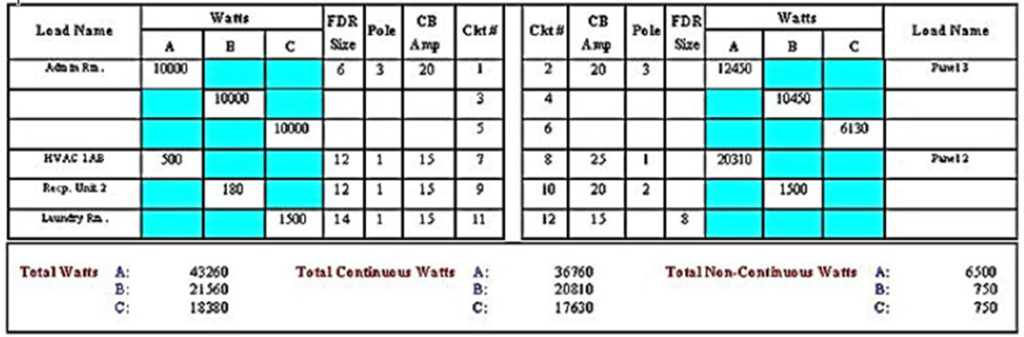
Why is Voltage Imbalance Study Important?
The effects of extensive voltage imbalances on power systems and equipment are broad and serious. A severe imbalance might dramatically decrease the equipment life cycles, considerably speed up the replacement cycle of equipment, and significantly increase system operation and maintenance costs. Furthermore, for a 3 phase 4 wire system, voltage imbalance leads to bigger neutral wire current and cause relay malfunction.
Voltage imbalances will create extra power loss, reduce system efficiency, decrease motor life cycles, etc. Also few abnormal functioning and maintenance circumstance also causes voltage imbalance and result in negative effects on equipment and systems. These conditions include such problems as bad electrical contacts, unsuitable shunt capacitor bank installation, single-phase operation of a motor, etc. These kinds of operation and maintenance conditions may not occur frequently. However, if they do occur they will bring about very serious problems for systems or equipment
Main objective of this study is:
- To determine the causes and effects of voltage unbalance on the distribution system and in user facilities.
- To determine the accepted definitions for calculating voltage unbalance and to clarify the related standards.
- To identify mitigation techniques for the distribution system and for industries.
Voltage imbalance percentage can be calculated using this formula:
% Unbalance= [Maximum deviation from average / Average of 3 phase to phase voltages]*100
To calculate the percentage deviation in three phases:
[Max (Im-Ir)(Im-Iy)(Im-Ib)*100] / Im
Where, Im is mean of currents in three phases
Im= (Ir+Iy+Ib)/3
Ir, Iy, Ib are phase currents.
Besides, an unbalance can also be measured by matching the strength of positive sequence currents in comparison to the negative sequence currents. The permissible limit in terms of percentage of negative phase sequence current over positive sequence current is 1.3% ideally but acceptable upto 2%.
How is Voltage Imbalance Study Done?
This study performed a comprehensive analysis of the issue of voltage unbalance on the power system. It will help utilities and industries understand the causes, effects, and definitions of voltage unbalance, identify mitigation techniques, and interpret related standards.
Several practical cases are taken into account to deal with voltage imbalances. The simulation results with problem defined and improvement measures will be later carried out based on the results from these cases. Few examples of these cases are:
- Bad connection of neutral wire
- Neutral wire broken
- Operation of three-phase motor under voltage imbalance
- Unsuitable capacitor bank installation
- Effects of Voltage Unbalance on Machines
- Effects of Voltage Unbalance on Power Electronic Converters and Drives
Such cases will be used to confirm the impacts of voltage imbalance on systems and equipment. Voltage imbalance not only causes extra energy loss, but also causes safety problems for a system. To prevent voltage imbalance, the balance problem should be taken into account through all the planning, design, installation and operation stages. This study will provide details, with theoretical analysis and explanation, to make it easy to grasp the impacts of voltage imbalance on systems and equipment. The results are of value to engineers for better design, operation and maintenance of power distribution systems
Mitigation Techniques for Facilities:
- Unbalanced loads are the main cause of unbalanced voltages on distribution circuits and thus a great deal can be gained by attempting to distribute single-phase loads equally across all three voltage phases. Electrical distrbution systems can be balanced by changing the system configuration through manual and automatic feeder switching operations to transfer loads among circuits. This reconfiguration can be performed to reduce losses, and has the natural tendency to balance loading among
- Unbalanced impedances, including transformers and their connections, are often the next largest contributor to unbalanced voltages. Therefore, proper selection of distribution transformers is a very important step in preventing voltage unbalance, paying particular attention to the balancing of open wye and open delta transformer banks.
- If the amount of unbalance tends to vary with the customer load, it is a good possibility that the transformer is the cause of the unbalanced condition. One way to determine the transformer banks contribution to voltage unbalance is to measure the voltages on the primary and the voltages on the secondary and calculate the percent unbalance at each point.
- In addition, overload conditions on the power system should always be corrected as soon as possible for a number of protection and safety reasons as well as unbalance compensation.
- Unbalance compensation can also be achieved by means of passive power filters that balance the load impedance, where the load current is balanced by adding reactive elements in parallel to the load.
- For variable loads, voltage unbalance in ac supply systems can be corrected by means of a shunt connected thrysitor-controlled static VAR compensator, where again the load current is balanced by adding reactive elements in parallel to the load.
- Within a user facility, all overloaded equipment should be corrected. In addition, passive power filters and shunt connected static VAR compensators, for mitigation on power systems, can be used for unbalance compensation in user facilities.
- Mitigation of the adverse effects of unbalanced voltage on adjustable speed drives (ASD) can be achieved through the use of properly sized ac-line and dc-link reactors as demonstrated in. The test results showed that connecting both the ac-line and dc-link reactors to the ASD has the greatest effect on phase-current unbalance, reducing it by more than half.
- Various relays can be introduced to protect induction motors from unbalanced voltages, where the relay settings and applications depend on the motor horsepower, loading, insulation class and service factor. The negative sequence current relays are more reliable and effective because relays measuring negative sequence voltage can lack the necessary sensitivity in some system and load configurations.